
How to Choose the Right Power Rack for Your Training Space
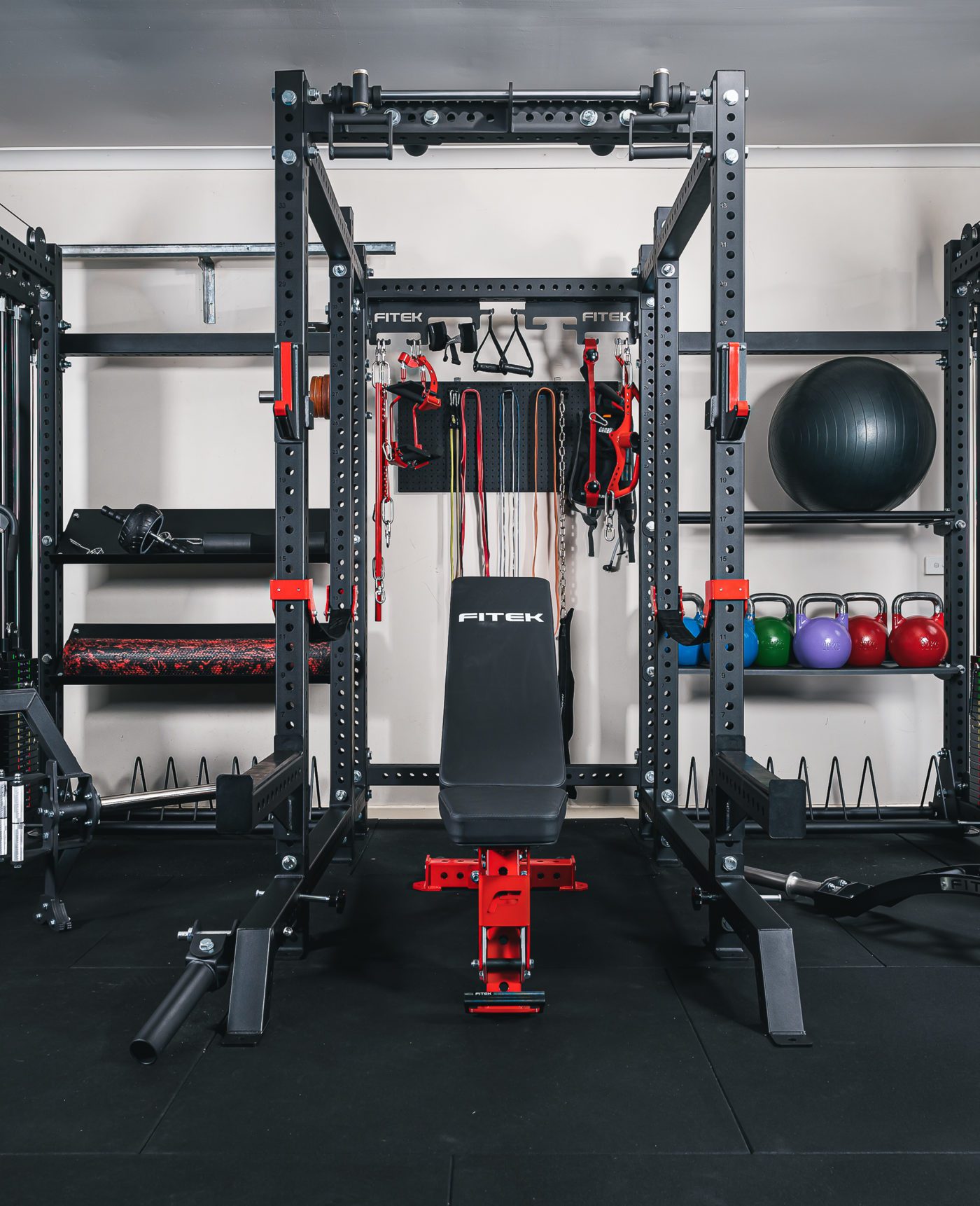
Choosing the right power rack is one of the most important decisions when setting up a strength training space. It isn’t just about strength ratings or brand names; the right rack should fit your space, adapt to your training needs, and grow with you over time. Below are the key factors to consider when selecting a power rack for home, school, or commercial use.
Key Factors to Consider When Choosing a Power Rack
1. Available Training Space
Before looking at features, measure your available floor space and ceiling height. Power racks vary in footprint and height, and you’ll need enough clearance for overhead lifts, pull-ups, and attachment use.
A rack that fits your space comfortably will always be more usable than one that feels cramped.
2. Rack Compatibility and Expandability
Modern strength training systems are increasingly modular. A power rack that supports expansion over time does far more than simply hold a barbell, it can evolve alongside your training goals, space constraints, and facility needs.
When selecting a rack, it’s important to consider whether it supports a wide range of commonly used attachments, such as:
- Chest-supported row attachments (e.g. Bridge pad)
- Lower-body accessories for movements like split squats, lunges and hip-dominant work (e.g. Leg roller, Landmine)
- Dip bar and pull-up attachments for vertical pushing and upper-body strength development
Expandability also goes beyond training movements. Many racks can be configured to include storage solutions such as:
- Dumbbell storage boards
- Kettlebell storage boards
- Bumper plates toasters
- Medicine ball or slam ball storage shelves
Some power racks can be upgraded with a cable pulley unit for exercises like lat pulldowns, rows, and face pulls. The pulley system usually mounts straight onto the rack using a crossbeam or pull-up bar, and can be combined with storage boards, bumper plates toasters to create an all-in-one setup that works as a power rack, cable machine, and storage system.
In addition, certain rack systems support the integration of a Smith machine attachment, allowing the power rack to be expanded into a full Smith machine without increasing its footprint. This modular approach delivers the guided bar path and training versatility of a Smith machine while retaining the compact layout of the original rack, ideal for facilities that require maximum functionality in limited space.
A rack that accommodates both training attachments and modular upgrades enables better space efficiency, reduced floor clutter, and a highly adaptable training environment that can grow over time.
3. Stability and Load Capacity
A power rack should feel solid under load. Look for sturdy construction, consistent hole spacing, and secure mounting options. Stability becomes especially important when training heavy or working with multiple athletes rotating through sessions.
4. Hole Spacing and Adjustment
Hole spacing and layout play an important role in how adaptable a power rack is. Racks that use a 4-way hole design on both the uprights and crossbeams allow attachments to be mounted from multiple directions, making it easier to configure the rack for different exercises and space requirements.
Power rack uprights with 21 mm diameter holes spaced at 50 mm intervals support a wide range of rack-mounted attachments while still allowing precise height adjustments for barbell movements. One advantage of this hole size is that it commonly pairs with 20 mm attachment pins, which strike a practical balance between size and strength. A 20 mm pin feels solid and secure under load without being overly bulky, making it a widely used and user-friendly standard for rack attachments.
Numbered markings along the vertical uprights further help users set and repeat bar positions consistently, reducing setup time and guesswork when moving between lifts such as squats and bench press.
5. Training Goals and Use Case
While racks are often labelled as “home” or “commercial,” the real difference comes down to build quality and suitability for use, not where the rack is placed. Whether a rack is used in a garage gym, a school, or a commercial facility, it still needs to be stable, well-built, and capable of supporting consistent training over time.
Rather than focusing on labels, it’s more useful to think about how the rack will actually be used. Consider:
- Who will be training on the rack
- How frequently it will be used
- Whether it needs to support multiple movement patterns and attachments
A quality power rack should meet these requirements regardless of environment, providing the same level of safety, versatility, and reliability for both home and shared training spaces.
Why Customizability Matters When Choosing a Power Rack
One of the most overlooked factors when choosing a power rack is how customizable the system is. Training spaces vary widely in size, layout, and purpose, and so do the needs of the people using them. A rack that works perfectly in one gym may be impractical in another if it can’t be adapted.
Customizable rack systems allow users to build a setup that fits their space rather than forcing their space to fit the rack. This might mean adjusting the rack configuration, choosing different upright heights, or selecting only the attachments that are actually needed. For home gyms, this can be the difference between a functional setup and one that feels cramped. For commercial or school environments, it allows the same rack to serve multiple training styles and athlete groups.
If your training space changes due to a renovation, relocation, or evolving requirements, a modular rack system allows you to retain the original structure and expand it over time by adding components such as additional uprights or crossbeams.
The ability to choose different accessories over time is just as important. Training needs change, spaces evolve, and a rack that supports modular add-ons can grow with the user instead of being replaced. For many customers, this flexibility is what turns a power rack from a single piece of equipment into a long-term training solution.
Why Attachments Matter More Than You Think
While the rack itself provides structure and safety, attachments often determine how versatile the setup becomes.
A well-chosen rack can support:
- Rack-mounted attachments
- Lower-body accessories for split squats and hip-dominant work
- Attachments that enable vertical pushing and upper-body accessory training
Instead of adding separate machines, many gyms now build training variety through rack attachments, saving both space and cost.
A Practical Example of a Modern Power Rack Setup
In many modern training spaces, the power rack acts as a central hub rather than a single-purpose station. Instead of locking users into one fixed layout, a modular rack system allows the setup to evolve as space, training style, or equipment needs change.
For example, a standard four-post rack can later be expanded into a six-post configuration by adding uprights and crossbeams, increasing stability and creating room for in-rack workouts and integrated storage without replacing the original rack. In tighter spaces, components such as storage frames or plate holders can be separated or repositioned to better suit the layout.
The same principle applies to cable systems. A dual pulley setup can remain integrated with the rack, or be reconfigured into separate freestanding pulley stations alongside a standalone power rack, depending on how the space is used. This flexibility allows a single rack system to function as a power rack, storage solution, and cable machine, without forcing a full rebuild when requirements change.
Rather than committing to a fixed setup on day one, this approach allows training spaces to grow gradually, adapting to real-world use over time.
Who Should Invest in a Full Power Rack?
A full power rack is a strong choice for:
- Home gym owners who train alone and want built-in safety
- Coaches working with multiple athletes
- Schools and performance centres
- Commercial gyms looking for space-efficient versatility
If your training includes barbell work, progressive loading, and multiple athletes of different sizes, a power rack is usually worth the investment.
Frequently Asked Questions
How much space do I need for a power rack?
This depends on rack size and ceiling height, but you’ll generally need enough clearance for overhead lifts and attachments. Always measure your space before choosing a rack.
Are power racks safe for solo training?
Yes. One of the biggest advantages of a power rack is the ability to train safely alone using adjustable safety arms or pins.
Do all power racks support attachments?
No. Attachment compatibility varies by rack design. If expandability matters to you, check compatibility before purchasing.
Final Thoughts
Choosing the right power rack isn’t about finding the biggest or most expensive option, it’s about finding a rack that fits your space, supports your training goals, and can grow with you over time.
By focusing on compatibility, stability, and expandability, you can build a training setup that remains useful for years, rather than one that needs replacing as your training evolves.
